All published articles of this journal are available on ScienceDirect.

Mapping 25 Years of Research on the Diabetes Mellitus–Apical Periodontitis Association: A Bibliometric Study
 iD
Florin Banica1
iD
iD
Florin Banica1
iD
Authors Info & Affiliations
Abstract
Introduction/Objective
This study aims to map twenty-five years of global scientific output and thematic evolution of the relationship between Diabetes Mellitus (DM) and Apical Periodontitis (AP) from 2000 to 2025.
Methods
Bibliometric data were extracted from the Web of Science Core Collection using VOSviewer to perform network visualization and quantitative mapping of publication trajectories, country/institutional co-authorship networks, and keyword co-occurrences.
Results
Publication output grew in three phases: incipient 2000–2010, steady growth 2011–2019, and rapid expansion after 2020, peaking in 2023. The United States and Brazil emerged as the most productive nations; a dominant Ibero-American research network is led by the University of Sevilla and São Paulo State University. Keyword clustering clearly shows the interdisciplinary nature of research connecting endodontic pathology, clinical treatment, and systemic disease. Specialized endodontic journals served as the primary publishing platforms, while highly cited papers focused on mechanisms driving a bidirectional link between DM and AP.
Discussion
The bibliometric data reflect the evolutionary trajectory from epidemiologic association toward mechanistic exploration and systemic integration. The mapping analysis highlights the importance of separating AP from marginal periodontal disease. The current literature is limited by diagnostic heterogeneity, incomplete reporting of diabetes duration, and the influence of confounding variables.
Conclusion
The DM–AP research domain has matured into a distinct, well-consolidated specialty within endodontic medicine. By mapping the publication timelines, dominant themes and current limitations, this study provides a reliable foundation for designing future, more rigorous clinical research. Future research must prioritize standardized diagnostic frameworks, uniform metabolic cut-offs and prospective longitudinal trials.
1. INTRODUCTION
Diabetes mellitus is a major global health burden with well-documented oral complications. Among these, apical periodontitis, an inflammatory disease of periapical tissues, has been increasingly associated with poor glycemic control and altered immune responses in diabetic patients. On the other hand, diabetes mellitus is known to have a significant impact on the quality of life, being a major source of morbidities, complications, and economic expense [1-3].
The level of glycated Hemoglobin (HbA1c) has been accepted as the most important marker for predicting the risk of the development of DM complications [4, 5]. According to previously reported papers, diabetic individuals may present a higher prevalence of Apical Periodontitis (AP), larger periapical lesions, and delayed healing following root canal treatment compared with non-diabetic individuals [6-8]. It is important to make a clear distinction between inflammatory pathologies of different origins, particularly between Apical Periodontitis (AP) and marginal periodontitis. Both are inflammatory diseases of the tooth-supporting tissues, but their etiopathogenesis differs fundamentally. AP falls strictly within the diagnostic and therapeutic scope of endodontic medicine, which analyzes the metabolic dysregulation, the periapical immune response, and the healing process of pulpal tissue, rather than that of the marginal periodontal tissues [9-13].
The “two-way relationship” between diabetes and periodontitis is a subject of great interest to clinicians, as evidenced by the increasing number of publications in recent years [12-15]. Recent clinical trials have linked AP to elevated HbA1c and inflammatory markers in type 2 diabetes patients, showing that successful endodontic intervention can stabilize glycemic parameters. Although both diabetes types alter periapical tissue responses, primary clinical data are mostly reported from type 2 diabetes populations [16-20].
Although several systematic reviews and meta-analyses have examined the clinical link between DM and AP, the structural development of this research field has not been fully characterized [6, 12-16]. Key aspects such as publication trends, leading countries and institutions, collaboration networks, and thematic shifts over time remain underexplored. Bibliometric and science-mapping methods provide quantitative tools to visualize these patterns. They allow us to identify research hubs, track the evolution of concepts, and detect emerging topics.
To our knowledge, no previous bibliometric study has systematically mapped the global scientific structure specifically focusing on the relationship between diabetes mellitus and apical periodontitis over the past two and a half decades. Therefore, the aim of the present study was to conduct a comprehensive bibliometric and science-mapping analysis of publications on the association between diabetes mellitus and apical periodontitis between 2000 and 2025, using objective tools in order to characterize publication trends, research productivity, collaboration networks, and thematic evolution.
2. MATERIALS AND METHODS
2.1. Data Sources and Search Strategy
The Web of Science Core Collection (WoSCC) served as the primary data source for this bibliometric analysis due to its robust citation indexing and software compatibility.
The same search strategy was also applied in PubMed. However, because PubMed lacks complete citation metrics, only Web of Science data were used for quantitative mapping. The search covered publications from January 1, 2000 to December 31, 2025. The final search was performed on February 8, 2026. Only peer-reviewed articles and reviews published in English were included. The search string was:
TS=((“apical periodontitis” OR “periapical periodontitis” OR “periapical lesion*” OR “periapical radiolucency” OR “endodontic infection*” OR “root canal treatment” OR “root canal therapy” OR “pulp* inflammation” OR “pulp necrosis”) AND (“diabetes mellitus” OR “diabetic” OR “hyperglycemia” OR “glycemic control” OR “HbA1c”)) NOT TS=(“marginal periodontitis” OR “periodontal disease” OR “periodontal pocket” OR “gingivitis” OR “scaling and root planning” OR “periodontal therapy” OR “attachment loss”). The NOT operator was used to exclude studies focused on marginal periodontitis and to isolate the relationship between diabetes and lesions of pulpal origin. After screening for eligibility, 174 records with complete bibliographic and citation data were included in the final dataset.
2.2. Bibliometric Mapping and Network Construction
Bibliometric analyses were performed using VOSviewer version 1.6.20. The following analyses were conducted: co-authorship analysis of authors, institutions, and countries; institutional and country collaboration mapping; keyword co-occurrence analysis; citation and co-citation network visualization. Association strength was used for network normalization. Full counting was applied to assign equal weight to each occurrence. To ensure clarity and interpretability, the following thresholds were set: keywords- minimum 5 occurrences for general mapping; authors- minimum 2 documents per author for co-authorship analysis; documents- minimum 10 citations for citation mapping. A thesaurus file was developed and applied in VOSviewer to merge lexical variants or synonyms and remove generic terms.
3. RESULTS
3.1. Publications Trend
The cumulative output from 2000 to 2025 shows three distinct phases in DM–AP research, as presented in Fig. (1). From 2000 to 2010, annual productivity was low, and contributions were scattered, indicating an incipient phase. From 2011 to 2019, publications increased steadily, suggesting the emergence of a reproducible research agenda. After 2020, output accelerated sharply and peaked in 2023. This reflects a transition to a mature and internationally visible research domain. Overall, the field has shifted from sporadic exploration to sustained, high-velocity growth in recent years.
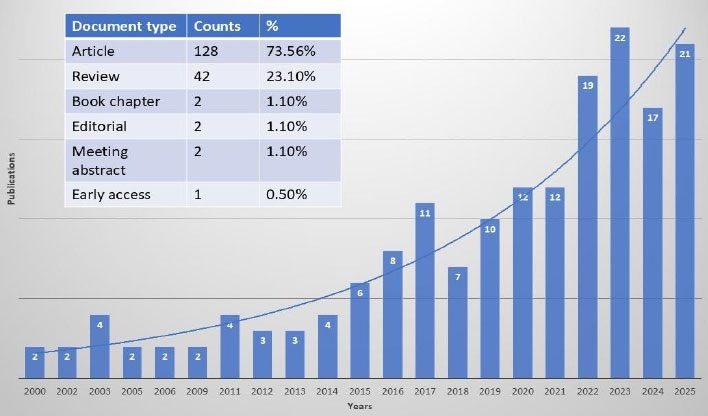
The evolution of the overall publications during the period 2000-2025.
The current literature is predominantly empirical. Original research articles accounted for 128 publications (73.56%), indicating that the field is driven by primary clinical, experimental, and observational studies. Review articles represented 42 publications (23.10%). This proportion suggests a consolidation of evidence, which is typical of a domain reaching structural maturity. Other publication formats contributed marginally to the core scientific collection.
3.2. Organizations and Countries
To characterize institutional productivity while preserving network interpretability, a minimum threshold of 2 publications per institution was applied. This retained 53 institutions out of 311 for descriptive ranking and network construction, indicating a subset of organizations that repeatedly contributed to the literature and formed the backbone of collaborative structure. The top 10 institutions showing the most important scientific production is presented in Table 1, while the institutional co-authorship map is displayed in Fig. (2), revealing a multi-hub collaboration structure with geographically coherent clusters.
| Affiliations | Record Count | % |
|---|---|---|
| University of Sevilla | 18 | 10.345 |
| Sao Paulo State University | 16 | 9.135 |
| University of Barcelona | 7 | 4.023 |
| King’ s College London | 7 | 4.023 |
| King Saud University | 6 | 3.448 |
| University of Connecticut | 5 | 2.874 |
| University of North Carolina | 5 | 2.874 |
| Pontificia Universidade Catolica do Rio Grande do Sul | 4 | 2.299 |
| Umm Al Qura University | 4 | 2.299 |
| University of Michigan | 4 | 2.299 |
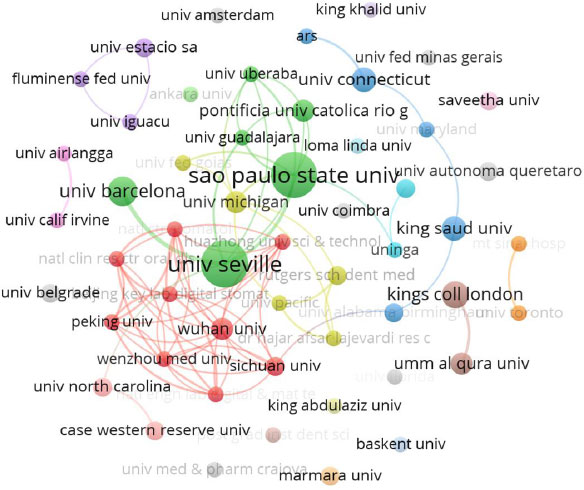
Network map of the most active organizations during the period 2000-2025.
The green cluster is centered on São Paulo State University, which serves as a major hub and has strong collaborations with institutions such as the University of Seville, University of Barcelona, and Pontifical Catholic University of Rio Grande do Sul, suggesting an active Ibero-American research network. The red cluster includes predominantly Chinese institutions, such as Peking University, Wuhan University, Sichuan University, and Wenzhou Medical University, reflecting strong intra-national collaboration and a dense network of partnerships. The blue cluster indicates a transnational collaboration between the University of Connecticut, Loma Linda University, and King Saud University. Finally, the brown/orange cluster highlights collaborations between King’s College London and Umm Al-Qura University from the Middle East.
Overall, the country collaboration network based on co-authorship parameters (Fig. 3) displays a multi-clustered international organization during the 2000–2025 period. Major bibliometric hubs are visible across Asia, South America, Europe, and North America, reflecting specialized regional groupings that remain integrated through collaborative authorship ties.
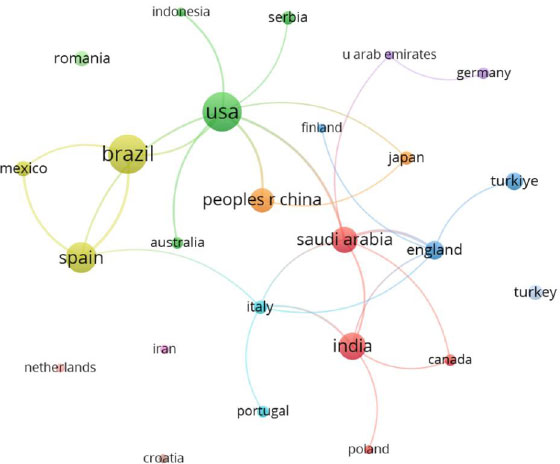
Network map of country collaboration based on co-authorship during the period 2000-2025.
The network architecture reveals the United States, India, and Saudi Arabia as the primary centers of research activity, characterized by prominent node sizes and bridges across different geographic regions. The network map highlights three major collaborative clusters:
- Ibero-American Cluster (Yellow) reflecting research collaborations between Brazil, Spain, and Mexico, based on geographic proximity and linguistic heritage.
- Middle Eastern-Asian-North American Axis (Red) showing collaborative links between Saudi Arabia, India, and Canada.
- European Cluster (Blue/Purple) Integrating England, Italy, Portugal, and Germany.
The dense lines connecting the USA with several distinct groups (such as China, Brazil, Serbia, and Finland) illustrate a well-integrated, globalized research strategy. In contrast, nations located on the periphery of the map (e.g., Romania, the Netherlands, and Croatia) reflect more localized or emerging involvement in the international scientific network.
The quantitative assessment of the research output in terms of the most productive countries is presented in Table 2.
| Countries/Regions | Record Count | % |
|---|---|---|
| USA | 35 | 20.115 |
| Brazil | 34 | 19.54 |
| Spain | 21 | 12.069 |
| India | 16 | 9.195 |
| Saudi arabia | 15 | 8.621 |
| People’s R china | 13 | 7.471 |
| England | 8 | 4.598 |
| Turkiye | 7 | 4.023 |
| Mexico | 5 | 2.874 |
| Romania | 5 | 2.874 |
3.3. Assessment of the Most Relevant Journals
The top 10 of the most relevant journals dealing with the topic of this bibliometric research is presented in Table 3.
| Publication Titles | IF/2024 | JCI/2024 | Records Count | % |
|---|---|---|---|---|
| Journal of Endodontics | 3.6 | 1.71 | 34 | 19.540 |
| International Endodontic Journal | 7.1 | 2.08 | 22 | 12.644 |
| Clinical Oral Investigations | 3.1 | 1.29 | 6 | 3.448 |
| Journal of Clinical Medicine | 2.9 | 0.9 | 6 | 3.448 |
| Australian Endodontic Journal | 1.5 | 0.59 | 4 | 2.299 |
| Odontology | 2.4 | 0.93 | 4 | 2.299 |
| Applied Sciences Basel | 2.5 | 0.53 | 3 | 1.724 |
| Archives of Oral Biology | 2.1 | 1.09 | 3 | 1.724 |
| Journal of Applied Oral Science | 2.6 | 1.05 | 3 | 1.724 |
| Oral Diseases | 2.9 | 1.09 | 3 | 1.724 |
The ranked source analysis identified a concentration of publications in a limited number of core journals, with the Journal of Endodontics being the most productive source, accounting for 34 publications (19.54%), followed by the International Endodontic Journal, which contributed 22 publications (12.64%). Beyond this group, individual journals each accounted for less than 4% of publications. The source distribution pattern shows a concentration of output within a limited number of high-frequency journals, followed by a progressively dispersed distribution across additional sources.
3.4. Assessment of the Most Prolific Researchers and Collaboration Map in the Field During the Period 2000-2025
To construct the co-authorship network, a minimum threshold of 2 publications per author was applied. Out of 871 identified authors, 76 authors met this criterion and were included in the co-authorship analysis, allowing visualization of authorship links among the most frequently publishing contributors. The top 10 most prolific authors are reported in Table 4, together with the corresponding counts and percentages of the total dataset. The two highest-output authors were Segura-Egea, Juan J., with 18 publications (10.35%), and Cintra, Luciano Tavares Angelo, with 11 publications (6.32%). Overall, the author productivity profile showed a higher publication share among the top-ranked contributors, followed by decreasing individual contributions across the remaining included authors.
| Researcher Profile | Affiliation | Records Count | % | H index/ Citations (without self- citations) | Average Citations/item |
|---|---|---|---|---|---|
| Segura-Egea, Juan J. | University of Sevilla | 18 | 10.345 | 39/ 3,906 | 28.15 |
| Cintra, Luciano Tavares Angelo | São Paulo State University | 11 | 6.322 | 35/ 2,828 | 18.16 |
| Fouad, Ashraf F. | University of Alabama Birmingham | 10 | 5.747 | 30/ 3,513 | 26.52 |
| Martin-Gonzalez, Jenifer | University of Sevilla | 10 | 5.747 | 20/1,431 | 29.28 |
| Velasco-Ortega, Eugenio | University of Sevilla | 8 | 4.598 | 30/ 2,712 | 24.16 |
| Lopez-Lopez, Jose | University of Santander | 7 | 4.023 | 10/ 411 | 7.11 |
| Cabanillas-Balsera, Daniel | University of Sevilla | 6 | 3.448 | 14/ 601 | 17.74 |
| Gomes Filho, João Eduardo | São Paulo State University | 6 | 3.448 | 5/ 78 | 6.31 |
| Castellanos-Cosano, L | University of Sevilla | 5 | 2.874 | 18/ 978 | 31.91 |
| Niazi, Sadia A. | King's College London | 5 | 2.874 | 15/ 619 | 18.3 |
The author co-authorship network (Fig. 4) reveals a topology comprising several research clusters. Nodes represent individual investigators, with their sizes proportional to publication output, while colors delineate specific collaborative clusters determined by the VOSviewer algorithm. The largest cluster (red) features prominent researchers including Angelo L.T. Cintra, João Eduardo Gomes-Filho, De Azevedo Queiroz, India Olin, Edison Ervolino, Mariane Maffei Azuma, and Fernando Yamamoto Chiba. The central role in coordinating collaborative research activities is played by the authors Angelo Cintra and Gomes-Filho. The second major community (green) consists of Juan José Segura-Egea, José Lopez-Lopez, Eugenio Velasco-Ortega, Enric Jane-Salas, Albert Estrugo-Devesa, and José Maria Llamas-Carreras. This group likely reflects a well-established European research alliance, with Segura-Egea acting as a critical topological connector. The third cluster (blue), which includes Carlos Estrela, Flavio Duarte Faria, and Leopoldo Cosme-Silva, serves as an intermediary function, facilitating cross-community knowledge translation. Next, the purple cluster-comprising the authors Jenifer Martin-Gonzalez and Daniel Cabanillas-Balsera-maintains moderate connectivity with the core network as a smaller community. Finally, the yellow cluster represents a peripheral collaboration group consisting of researchers like Ashraf F. Fouad, James C. Kulild, Maha Alghofaily, and Andre Mickel. Despite its internal cohesion, the limited connectivity to the core suggests a specialized or independent research trajectory of this small group. Collectively, the network demonstrates a modular structure where specialized research communities are integrated through key bridging authors, highlighting the vital role of international collaborations.
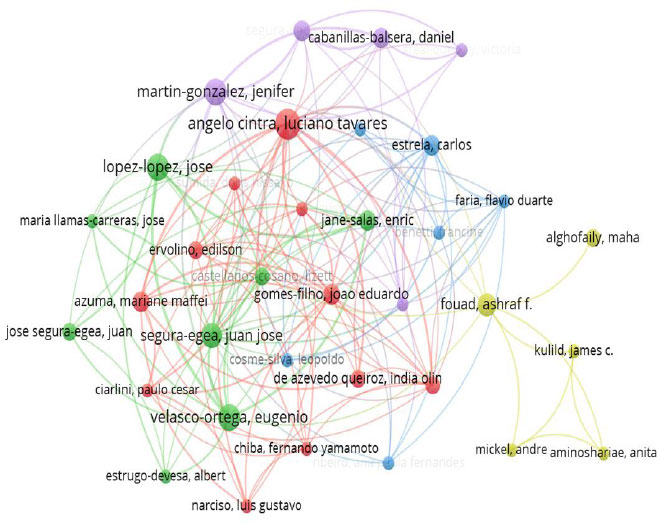
Authors network map and collaboration between 2000 -2025.
3.5. Network Map of High-frequency Co-occurrence of Keywords and Related Terms
For keyword analysis and mapping, 20 keywords out of 817 met the minimum threshold of 10 occurrences. The high-frequency network is presented in Fig. (5), which shows three main clusters and co-occurrence relationships.
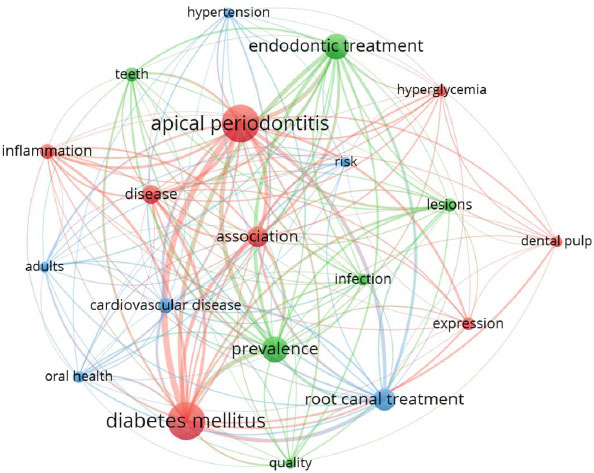
The network map of keywords and related terms co-occurrence during the period 2000-2025.
The red cluster focuses on the core pathophysiological links centering on “apical periodontitis” and “diabetes mellitus”, along with “inflammation”, “hyperglycemia”, and “association”. This cluster reflects studies on biological mechanisms linking systemic disorders and endodontic inflammation. The green cluster focuses on clinical epidemiology and therapeutics, based on the terms “endodontic treatment”, “prevalence”, “infection”, and “quality”. It includes investigations dedicated to clinical management and epidemiological prevalence. The blue cluster contains “root canal treatment”, “cardiovascular disease”, “oral health”, and “risk”. It represents emerging research on links between oral infections and systemic conditions. Overall, the network demonstrates the interdisciplinary nature of research connecting endodontic pathology, clinical treatment, and systemic disease.
3.6. The Most Influential Manuscripts Related to Research Topics in the Period 2000-2025
Table 5 details the top 10 most cited publications in the dataset, highlighting the foundational pillars of this research domain. These core documents accumulated 1,414 citations, yielding a high mean of 141.4 citations per article. The premier publication in the dataset is the landmark review “Endodontic medicine: connections between apical periodontitis and systemic diseases” by Segura-Egea et al. (2015) with 237 citations, followed by Verhulst et al. (2019) and Fouad et al. (2002), which received 182 citations each. Citation density is highly concentrated at the apex; the top three publications alone account for approximately 42.5% of the cumulative citations within this top-10 cohort. The publication timeline for these highly cited works spans from 2002 to 2019. In terms of journal metrics, these papers appeared in high-impact journals with Impact Factors (IFs) ranging from 5.4 to 7.1, with the most-cited paper published in the journal boasting the maximum IF = 7.1 Author recurrence was notable within this elite group; A.F. Fouad and J.J. Segura-Egea each authored two top papers, showing their positions as the most prolific contributors in the overall productivity rankings.
| First author/ year | Article Title | Source Title | IF/2024 | Citations | Ref. |
|---|---|---|---|---|---|
| Segura-Egea, JJ 2015 |
Endodontic medicine: connections between apical periodontitis and systemic diseases | International endodontic journal | 7.1 | 237 | [12] |
| Verhulst, MJL 2019 |
Evaluating All Potential Oral Complications of Diabetes Mellitus | Frontiers in endocrinology | 4.6 | 182 | [15] |
| Fouad, AF 2002 |
PCR-based identification of bacteria associated with endodontic infections | Journal of clinical microbiology | 5.4 | 182 | [16] |
| Holland, R 2017 |
Factors affecting the periapical healing process of endodontically treated teeth | Journal of applied oral science | 2.6 | 130 | [19] |
| López-López, J 2011 |
Periapical and Endodontic Status of Type 2 Diabetic Patients in Catalonia, Spain: A Cross-sectional Study | Journal of endodontics | 3.6 | 100 | [20] |
| Mauri-Obradors, E 2017 |
Oral manifestations of Diabetes Mellitus. A systematic review | Medicina oral patologia oral y cirugia bucal | 2.1 | 147 | [17] |
| Fouad, AF 2003 |
The effect of diabetes mellitus on endodontic treatment outcome - Data from an electronic patient record | Journal of the american dental association | 3.5 | 146 | [18] |
| Segura-Egea, JJ 2012 |
Diabetes mellitus, periapical inflammation and endodontic treatment outcome | Medicina oral patologia oral y cirugia bucal | 1.13 | 99 | [21] |
| Marotta, PS 2012 |
Type 2 Diabetes Mellitus and the Prevalence of Apical Periodontitis and Endodontic Treatment in an Adult Brazilian Population | Journal of endodontics | 3.6 | 96 | [22] |
| Bender, IB 2003 |
Diabetes mellitus and the dental pulp | Journal of endodontics | 3.6 | 95 | [23] |
4. DISCUSSION
This bibliometric and science-mapping analysis decodes twenty-five years of research tracking how Diabetes Mellitus (DM) impacts Apical Periodontitis (AP). By processing publication timelines, keyword clusters, and citation patterns, we can see exactly how the field has shifted. It began as a collection of isolated clinical observations and has grown into a highly structured, mechanistically driven branch of “endodontic medicine” [1, 2, 5]. The first key finding is the rapid growth of the field. Publication output followed three phases: an incipient period, steady growth, and a sharp acceleration after 2020 that peaked in 2023, as shown in Fig. (1). This trajectory suggests that early clinical evidence and epidemiological signals generated a reproducible research agenda. The predominance of original articles (73.56%) further indicates that the field is driven by primary data rather than by secondary reviews. Over time, however, our keyword clustering shows that researchers stopped simply counting cases. Instead, they began grouping patients by metabolic control and tracking specific treatment outcomes.
Introducing glycemic control metrics-specifically HbA1c testing-into endodontic studies changed the scientific landscape. Rather than sorting patients into a basic “diabetic vs. non-diabetic” binary, modern studies examine metabolic gradients [4, 13]. This allows researchers to see how varying levels of blood sugar control alter how long a lesion lasts or how well it heals. This shift represents a move toward more realistic, biologically plausible models of disease interaction.
Another key finding relates to research themes. Our study highlights the importance of separating AP from marginal periodontal disease. As shown in the keyword co-occurrence map (Fig. 5), “diabetes mellitus” and “apical periodontitis” lock together in a dedicated cluster. This clean visual separation keeps clinical endodontic variables isolated from general systemic markers [20, 22-26].
Because AP is the main reason patients seek root canal therapy, these terms naturally appear as high-frequency keywords with strong ties to the rest of the dataset. By filtering out marginal periodontal tags, the map highlights an isolated research landscape focused entirely on how diabetes alters root canal biology and periapical bone loss. While marginal periodontitis involves the supporting structures of the tooth, AP stems almost exclusively from infections inside the root canal itself [7, 19]. Keeping these two fields separate prevents data contamination and keeps the focus centered on endodontics.
Periapical healing is notoriously unpredictable. It depends heavily on the patient’s immune status, how well the infection is controlled, and the physical quality of the root canal filling [8, 11]. Today, AP is viewed as a biofilm-driven disease where complex bacterial communities clash with the host’s immune system. In a diabetic patient, metabolic issues act as a powerful modifier rather than a direct cause. This nuanced view explains why the thematic clusters in our network have diversified so much over time.
This structural evolution shows that the field has successfully consolidated under the umbrella of “endodontic medicine,” pushing periapical inflammation into broader systemic health discussions [13, 14, 27-29]. Narrative reviews have helped tie these pieces together. At the same time, prospective trials monitoring inflammatory markers alongside blood sugar levels have pushed the field into practical, translational medicine. We still cannot definitively prove cause-and-effect, but tracking systemic biomarkers proves that this field has grown up.
The third finding of our work concerns research leadership and collaboration. Geographically, the United States and Brazil dominate this research space. Our institutional analysis highlights a tight, highly productive Ibero-American network led by the University of Sevilla and São Paulo State University, which forms the true backbone of global co-authorship. Interestingly, even though the USA, India, and Saudi Arabia act as the largest international hubs, distinct Chinese and European clusters still stand out. This proves that geographic proximity and native language still heavily influence who collaborates with whom. The data also points to a tight-knit core of highly active researchers, led by Juan J. Segura-Egea and Luciano T. Angelo Cintra, who are responsible for a massive portion of the published literature.
Furthermore, the fact that most high-impact papers are published in top-tier journals like the Journal of Endodontics and the International Endodontic Journal demonstrates that this research remains firmly rooted within the core endodontic scientific community, rather than spilling over into general medicine.
5. LIMITATIONS
This study has several limitations that warrant discussion. Methodologically, the literature is still dominated by observational and cross-sectional designs. While this is normal for a developing field, it limits our ability to make definitive claims. Diagnostic variation remains a massive hurdle. Different studies use different diagnostic tools and thresholds, which likely explains why reported prevalence rates and healing rates vary widely across the literature [28-30].
Furthermore, metabolic tracking is highly inconsistent. Studies use wildly different HbA1c cut-offs, rarely report how long a patient has had diabetes, and often fail to adjust for critical confounding variables like smoking, obesity, medications, and other systemic illnesses. This makes it very difficult to compare studies directly and leaves room for possible bias. Because of these flaws, the reported links between DM and AP should be viewed as shifting estimates rather than universal facts.
The bibliometric method itself also requires a cautious approach. Pulling data from a single index database may influence publication density and geographic trends. Additionally, bibliometric data is inherently retrospective. Citation metrics take time to build, which naturally favors older papers over newer research. Finally, computer-driven clustering algorithms are helpful approximations, but they do not represent absolute conceptual boundaries.
6. CLINICAL RELEVANCE, CHALLENGES AND STRATEGIC FUTURE RESEARCH
The strong association between diabetes and apical periodontitis forces a shift in how we approach everyday endodontic practice. For a clinician, treating a patient with poorly managed diabetes means dealing with compromised immune cells, sluggish vascular responses, and delayed tissue repair. This reality directly impacts how periapical lesions develop, spread, and heal. Endodontists can no longer view the tooth in isolation; we must take into account the patient histories. Documenting a patient’s diabetic status and tracking their recent HbA1c trends should be standard practice to guide recall intervals and risk stratification. When a diabetic patient presents with extensive periapical radiolucencies, tighter radiographic monitoring and a strict, structured recall schedule are entirely justified. If a periapical lesion proves refractory or symptoms persist despite excellent clinical care, opening a direct line of communication with the patient’s primary care physician or endocrinologist is the most logical next step. This interdisciplinary approach ensures we treat the patient holistically, without compromising our established clinical standards. Even though studies consistently link diabetes to poor endodontic healing, truly robust, long-term longitudinal data remains frustratingly scarce. The literature still leans far too heavily on simple correlations rather than direct mechanistic proof, which means we must be highly cautious when claiming cause-and-effect [28-30]. Studies use wildly different radiographic criteria, conflicting definitions of “endodontic success,” and completely inconsistent blood sugar thresholds to group their patients. This makes comparing data across different trials nearly impossible. Without tracking local periapical fluid mediators alongside systemic blood markers, we cannot build precise, dose-response risk models. Future research must prioritize five strategic areas:
a) Longitudinal Cohort Studies: We urgently need prospective trials with baseline metabolic data and long-term follow-up schedules. Establishing a clear timeline of events is the only way to prove whether metabolic control directly drives periapical healing dynamics.
b) Unified Diagnostic Frameworks: The global research community must agree on standardized periapical indices, uniform imaging protocols, and identical metabolic cut-offs to make cross-study comparisons meaningful.
c) Integrated Multi-Marker Modelling: Future trials should look beyond isolated HbA1c numbers. Combining systemic inflammatory markers with local periapical fluid samples will allow us to shift from basic binary grouping to dose-response risk analysis.
d) Translational Interventional Trials: We need controlled, interventional studies that track root canal outcomes across tightly stratified diabetic groups. Additional microbiological profiling will help us figure out exactly why and how healing stalls at the cellular level.
e) Cross-Disciplinary Consortia: Building international, multi-center, and interdisciplinary research groups (endodontists, diabetologists, epidemiologists) will dramatically improve data quality and ensure these findings carry weight in the broader medical community.
CONCLUSION
In conclusion, the mapped literature over the past twenty-five years shows a clear, logical evolution: the field has moved away from basic epidemiological tracking and the collection of isolated clinical observations toward deep mechanistic mapping and systemic integration, metabolic stratification, studying biofilm persistence, and tracking biomarker responses. The DM–AP interface is consolidating its place as a distinct subfield of endodontic medicine. By mapping the publication timelines, dominant themes, and persistent limitations, this study provides a reliable foundation for designing future, more rigorous clinical research. Our mapping shows a sharp spike in publication volume since 2020, powered by a deeply rooted Ibero-American network alongside major global research hubs in the US, India, and Saudi Arabia. To overcome the limitations of simple correlation, future research must prioritize long-term longitudinal designs, uniform diagnostic criteria, and controlled interventional studies.
AUTHORS’ CONTRIBUTIONS
The authors confirm their contributions to the paper as follows: A.M., F.B., M.M. and S.C.: Conceptualization; F.B.: Methodology; F.B.: Software; F.B. and S.C.: Formal analysis; M.M., A.M., F.B., S.C.: Writing-original draft preparation; A.M., F.B. and S.C.: Writing-review and editing. All authors have read and agreed to the published version of the manuscript.
LIST OF ABBREVIATIONS
| DM | = Diabetes Mellitus |
| AP | = Apical Periodontitis |
| IFs | = Impact Factors |
| WoSCC | = Web of Science Core Collection |
AVAILABILITY OF DATA AND MATERIALS
The data and supportive information is available within the article.
ACKNOWLEDGEMENTS
Declared none.