All published articles of this journal are available on ScienceDirect.

Autoclave Sterilization Differentially Degrades Cyclic Fatigue Resistance in EdgeFile X7 and Fanta File Nickel-titanium Rotary Instruments
 iD
iD
Authors Info & Affiliations
Abstract
Background
The effect of autoclave sterilization on the fatigue life of modern heat-treated Nickel-Titanium (NiTi) files is debated. This study quantifies this effect on two contemporary file systems.
Objective
To evaluate the impact of 0, 1, and 2 autoclave cycles on the cyclic fatigue resistance of EdgeFile X7 (FireWire™) and Fanta File (AF-H Wire).
Methods
A total of 84 new files (25/.06, n=14 per subgroup) were tested. After autoclaving (134°C, 18 min), files were rotated at 300 RPM in a standardized steel canal (60° curve, 5mm radius) until fracture. The Number of Cycles to Failure (NCF) was calculated and analyzed using two-way ANOVA. Fractured surfaces were examined with Scanning Electron Microscopy (SEM).
Results
A significant interaction between file type and sterilization was found (p < 0.001). EdgeFile had higher initial NCF (2649 ± 348) but showed a greater fatigue reduction after two cycles (38.6% loss). Fanta File had a lower initial NCF (1353 ± 168) but was more resistant to degradation (19.5% loss). Both file type (p < 0.001) and sterilization (p < 0.001) were significant factors. SEM confirmed fatigue failure in all samples.
Discussion
A significant interaction effect revealed that while EdgeFile X7 offers higher initial durability, its alloy is more susceptible to thermal degradation compared to the more stable Fanta File. Consequently, the cumulative damage induced by sterilization suggests that reuse protocols must be strictly limited to minimize the risk of intracanal fracture.
Conclusion
Autoclave sterilization significantly degrades the fatigue resistance of both systems, but the effect is material-dependent. The initially more durable EdgeFile was more susceptible to damage than the Fanta File. This data supports limiting the reuse of these instruments to ensure patient safety.
1. INTRODUCTION
Complete chemomechanical debridement of the root canal system is arguably the number one objective in endodontic treatment, and since the acceptance of nickel–titanium (NiTi) rotary files, this process has been revolutionized [1]. The unique superelasticity and shape-memory properties of NiTi root canal instruments enable more focused and efficient shaping of root canals, particularly in complex curved forms [2]. Cyclic fatigue and torsional loading are the two principal causes for instrument separation [3]. While that is still a major clinical problem, despite recent advances in instrument development, artifact remains an unresolved issue at this time. Cyclic fatigue is an instrument fracture that results from the fragmentation of the file while it is subjected to repetitive tensile and compressive stresses as it rotates within a passively curved canal, leaving its mark on the outcome [4].
A new series of NiTi instruments, which are manufactured by a different proprietary thermomechanical process [5], has been developed to minimize the risk of fracture and enhance clinical performance. Depending on the specific heat treatment employed, these thermomechanical treatments change the crystal structure of the alloy and shift the phase transition region (austenite, martensite, R-phase), which is activated to establish an ideal balance of flexibility, strength, and fatigue resistance against cyclic stressing [6, 7]. The FireWire™ treatment employed in the manufacture of Edge File X7 (EdgeEndo, Albuquerque, NM, USA) results in a very flexible file, as does the application of “AF-H Wire” technology, as introduced for Fanta File (Fanta Dental, Shanghai, China). Such ongoing improvements represent an evolution of endodontic metallurgy and are developed to provide the practitioner with improved, safer instruments [8].
Parallel to these materials' developments, financial limitations in clinical practice often require an increasing reuse of NiTi files. This constraint creates a firm requirement for sterilization by means such as steam autoclaving to prevent cross-contamination and ensure patient safety [9]. Nevertheless, there is still significant inconsistency and disputable supporting evidence in the literature regarding the impact of multiple autoclaving cycles on the mechanical and metallurgical properties of these advanced heat-treated alloys. Recent expert opinion and consensus recognise that dry heat and autoclave sterilization alter the mechanical behaviour of NiTi instruments, but the extent and type of these alterations vary depending on the file system and testing procedure [10].
A comprehensive 2024 review by Abdellatif et al. highlighted this controversy, noting that while some studies report a decrease in cyclic fatigue resistance after autoclaving, others suggest a potential increase, possibly due to a shape recovery effect or microstructural annealing [11]. This discrepancy is further complicated by variations in experimental protocols, such as testing at room temperature versus the more clinically relevant body temperature, which has been shown to decrease the fatigue strength of heat-treated instruments [11, 12]. Furthermore, recent studies have produced divergent results; Bardan et al. (2025) found that autoclaving did not affect the dynamic cyclic fatigue of several systems but did reduce torsional strength [13], whereas Patel et al. (2025) observed an increase in cyclic fatigue resistance for other file systems after sterilization [14].
This lack of consensus creates a significant knowledge gap for clinicians, who must make evidence-based decisions about the reuse of specific, contemporary file systems such as EdgeFile X7 and Fanta File. While some research has investigated the effects of sterilization on various NiTi instruments [15, 16], there is a paucity of data directly comparing these two popular, modern, heat-treated systems. Therefore, this study aimed to provide clarity by evaluating the impact of multiple autoclave sterilization cycles on the cyclic fatigue resistance of EdgeFile X7 and Fanta File. The null hypothesis was that autoclave sterilization would have no significant effect on the cyclic fatigue resistance of the tested instruments. The rationale for this study is rooted in the urgent clinical need to establish clear, evidence-based guidelines for the safe reuse of modern heat-treated NiTi files, thereby minimizing the risk of unexpected intracanal separation and ensuring optimal patient safety.
2. MATERIALS AND METHODS
2.1. File Selection and Grouping
A total of 84 new NiTi rotary files from two commercially available systems were used in this study: 42 EdgeFile X7 (Size 25/0.06, 25 mm length, EdgeEndo, Albuquerque, NM, USA) and 42 Fanta File (Size 25/0.06, 25 mm length, Fanta Dental, Shanghai, China). EdgeFile X7 features FireWire™ heat treatment technology, which produces a gold-colored alloy with enhanced flexibility and fatigue resistance. The files have a variable taper design with a maximum flute diameter of 1.0 mm. Fanta File utilizes AF-H Wire technology with blue heat treatment, designed for flexibility in narrow and calcified canals. All files were new, unused, and inspected under a stereomicroscope (20× magnification) prior to testing to ensure no manufacturing defects were present.
Each file system was divided into three subgroups (n=14 each) based on the number of autoclave sterilization cycles they underwent:
- Group 1 (Control): 0 sterilization cycles. A control group was included to establish baseline cyclic fatigue resistance before any thermal degradation, allowing for a precise evaluation of the difference between the pre- and post-autoclave states.
- Group 2: 1 sterilization cycle
- Group 3: 2 sterilization cycles
2.2. Sterilization Protocol
The autoclave (Lina, W&H, Bürmoos, Austria) was validated using biological indicators (Geobacillus stearothermophilus spores) prior to the study to confirm sterilization efficacy. Files in Groups 2 and 3 were sterilized at 134°C and a pressure of 2.1 bar, following standard protocols for endodontic instruments [4]. Each sterilization cycle consisted of a 3-minute heat-up phase, 15-minute sterilization phase, and a 10-minute drying phase, for a total cycle time of 28 minutes. The files were sterilized in their original sealed pouches to simulate clinical conditions.
2.3. Sample Size Calculation
Sample size was determined a priori using G*Power 3.1 software (Heinrich Heine University, Düsseldorf, Germany). Based on preliminary data and previous studies [12, 13], an effect size of 0.8, alpha error of 0.05, and power of 95% were used, yielding a minimum sample size of 14 files per group.
2.4. Cyclic Fatigue Testing
Cyclic fatigue testing was performed using a custom-fabricated stainless-steel artificial canal conforming to the geometry described in previous studies [4] and validated by ISO 3630-1 standards [17]. The canal featured a 60° angle of curvature, 5 mm radius of curvature, and an inner diameter of 1.5 mm. The point of maximum curvature was located 5 mm from the canal terminus. The canal was embedded in a transparent acrylic block to allow visual monitoring of file position during testing. The canal was lubricated with glycerin to reduce friction and simulate clinical conditions.
Each file was rotated using a torque-controlled endodontic motor (X-Smart Plus, Dentsply Sirona, Ballaigues, Switzerland) at a constant speed of 300 RPM and a torque of 2.5 Ncm. The Time to Fracture (TtF) was recorded in seconds using a digital stopwatch. The Number of Cycles to Failure (NCF) was calculated using the formula:
Speed RPM X Time (T) to fracture in minutes”.
All testing was conducted in a temperature-controlled laboratory environment maintained at 21 ± 2°C with 45 ± 5% relative humidity. All cyclic fatigue tests were performed by a single calibrated operator who underwent training with 20 practice files prior to the experimental phase. The operator was blinded to the file brand during testing, with files coded numerically. A second independent observer verified file positioning and recorded the time to fracture to ensure measurement accuracy.
2.5. Fracture Analysis
After fracture, the length of the separated fragment was measured using a digital caliper (accuracy ± 0.01 mm, Mitutoyo, Kawasaki, Japan). The distance from the file tip to the fracture point was recorded to determine the fracture location relative to the point of maximum canal curvature.
All fractured file fragments were ultrasonically cleaned in distilled water for 5 minutes, dried, and mounted on aluminum stubs. The fracture surfaces were examined using scanning electron microscopy (SEM, JEOL JSM-6390LV, Tokyo, Japan) at 500× and 2000× magnifications under 15 kV accelerating voltage. Fractographic features were analyzed to identify crack initiation sites, propagation patterns, and final fracture zones. Representative SEM images were captured for each experimental group.
2.6. Statistical Analysis
Data were analyzed using SPSS software (Version 26.0, IBM, Armonk, NY, USA; https://www.ibm.com/spss). The normality of the data was assessed using the Shapiro-Wilk test, and homogeneity of variance was evaluated using Levene's test. As all data met the assumptions of normality (p > 0.05) and equal variance (p > 0.05), parametric tests were employed for statistical analysis.
A two-way Analysis of Variance (ANOVA) was used to assess the effects of file type and sterilization cycles on NCF, as well as their interaction. Post-hoc comparisons were performed using Tukey's HSD test. Effect sizes were calculated using partial eta-squared (η2p), with values of 0.01, 0.06, and 0.14 representing small, medium, and large effects, respectively. All mean values are reported with 95% Confidence Intervals (CI) in addition to standard deviations. The level of statistical significance was set at p < 0.05.
All data were recorded in duplicate by two independent observers and entered into a password-protected electronic database. Any discrepancies were resolved by re-measurement. Files that fractured outside the curved portion of the canal or showed signs of torsional failure (unwinding) were excluded from analysis and replaced.
3. RESULTS
The results of the cyclic fatigue testing are summarized in the tables and figures below. Both file type and the number of sterilization cycles had a significant effect on the cyclic fatigue resistance of the instruments (p < 0.001).
3.1. Time to Fracture and Number of Cycles to Failure
EdgeFile demonstrated significantly higher initial fatigue resistance compared to Fanta File. The mean NCF for the control group of EdgeFile was 2649 ± 348 (95% CI: 2451-2847), while for Fanta File, it was 1353 ± 168 (95% CI: 1258-1448). After two sterilization cycles, the NCF of EdgeFile was reduced by 38.6% to 1626 ± 90 (95% CI: 1575-1677), while Fanta File showed a 19.5% reduction to 1089 ± 281 (95% CI: 932-1246). The distributions of fracture times and the progressive reduction in fatigue life are illustrated in Figs. (1 and 2), respectively. Detailed results for TtF and NCF are presented in Table 1 and Table 2.
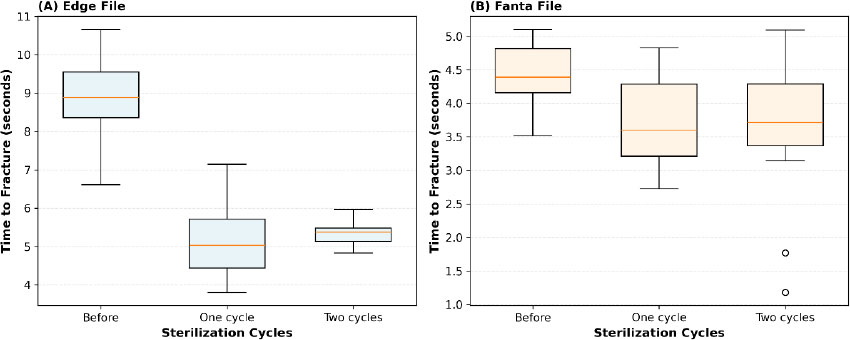
Box-and-whisker plots showing the distribution of time to fracture for (A) Edge File and (B) Fanta File across the three sterilization conditions. The boxes represent the interquartile range (IQR), the horizontal line within each box indicates the median, and the whiskers extend to 1.5× IQR. Outliers are shown as individual points.
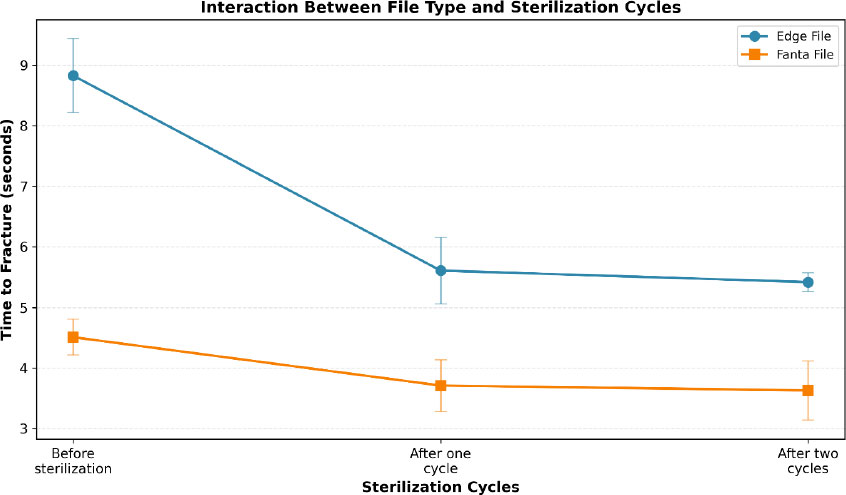
Interaction plot illustrating the differential effect of sterilization cycles on the time to fracture of Edge File and Fanta File. Error bars represent 95% confidence intervals. The diverging slopes demonstrate the significant interaction effect (p < 0.001), with Edge File showing greater susceptibility to sterilization-induced degradation despite higher initial resistance.
| File Type | Sterilization Cycles |
Time to Fracture (seconds) Mean ± SD (95% CI) |
Number of Cycles to Failure Mean ± SD (95% CI) |
|---|---|---|---|
| EdgeFile X7 | 0 (Control) | 529.8 ± 69.6 (490.2-569.4) |
2649 ± 348 (2451-2847) |
| EdgeFile X7 | 1 | 386.4 ± 54.2 (355.8-417.0) |
1932 ± 271 (1779-2085) |
| EdgeFile X7 | 2 | 325.2 ± 18.0 (315.0-335.4) |
1626 ± 90 (1575-1677) |
| Fanta File | 0 (Control) | 270.6 ± 33.6 (251.6-289.6) |
1353 ± 168 (1258-1448) |
| Fanta File | 1 | 243.0 ± 42.0 (219.0-267.0) |
1215 ± 210 (1095-1335) |
| Fanta File | 2 | 217.8 ± 56.2 (186.4-249.2) |
1089 ± 281 (932-1246) |
Note: All values represent means ± standard deviations with 95% confidence intervals in parentheses. n = 14 files per group.
| File Type | Sterilization Cycles | NCF Mean ± SD (95% CI) |
Percentage Reduction (%) from Control |
|---|---|---|---|
| EdgeFile X7 | 0 (Control) | 2649 ± 348 (2451-2847) |
0.0 (Baseline) |
| EdgeFile X7 | 1 | 1932 ± 271 (1779-2085) |
27.1 |
| EdgeFile X7 | 2 | 1626 ± 90 (1575-1677) |
38.6 |
| Fanta File | 0 (Control) | 1353 ± 168 (1258-1448) |
0.0 (Baseline) |
| Fanta File | 1 | 1215 ± 210 (1095-1335) |
10.2 |
| Fanta File | 2 | 1089 ± 281 (932-1246) |
19.5 |
Note: Percentage reduction calculated as [(Control NCF - Sterilized NCF) / Control NCF] × 100. n = 14 files per group.
3.2. Interaction Effects
A significant interaction effect was observed between file type and the number of sterilization cycles (F = 12.45, p < 0.001, η2p = 0.42), as illustrated in the interaction plot (Table 3 and Fig. 3). This large effect size indicates that the two file systems responded differently to the sterilization process. EdgeFile, while initially more durable, showed a more pronounced reduction in fatigue resistance with each sterilization cycle compared to Fanta File.
| Source of Variation | Sum of Squares | Degrees of Freedom | Mean Square |
F-value (p-value) |
Partial η2 (Effect Size) |
|---|---|---|---|---|---|
| File Type | 8,456,234 | 1 | 8,456,234 | 58.685 (< 0.001) |
0.58 (Large) |
| Sterilization Cycles | 4,812,567 | 2 | 2,406,284 | 16.688 (< 0.001) |
0.35 (Large) |
|
File Type × Sterilization Cycles (Interaction) |
1,795,432 | 2 | 897,716 | 12.450 (< 0.001) |
0.42 (Large) |
| Error (Within Groups) | 11,234,876 | 78 | 144,037 | - | - |
| Total | 26,299,109 | 83 | - | - | - |
Note: Effect size interpretation: η2 = 0.01 (small), 0.06 (medium), 0.14 (large). All main effects and interaction effects were statistically significant at p < 0.001. n = 84 total observations (6 groups × 14 files per group).
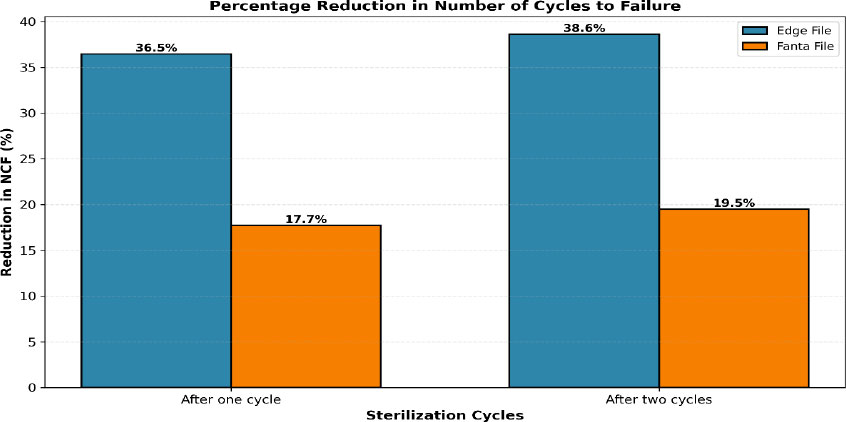
Bar chart showing the percentage reduction in the Number of Cycles to Failure (NCF) for each file type after one and two sterilization cycles. Values are displayed on each bar. EdgeFile demonstrates greater percentage loss despite higher initial resistance, highlighting the differential response to autoclaving.
3.3. Statistical Analysis Results
Two-way ANOVA revealed significant main effects for both file type (F = 58.685, p < 0.001, η2p = 0.58) and sterilization cycles (F = 16.688, p < 0.001, η2p = 0.35), as shown in Table 3. The large effect sizes confirm the substantial impact of both factors on cyclic fatigue resistance.
3.4. Fracture Location Analysis
The mean fracture location was 4.12 ± 0.52 mm from the file tip for EdgeFile and 3.89 ± 0.48 mm for Fanta File, with no significant difference between groups (p = 0.124), as shown in Fig. (4). All fractures occurred within the curved portion of the canal, confirming that failure was due to cyclic fatigue rather than torsional stress.
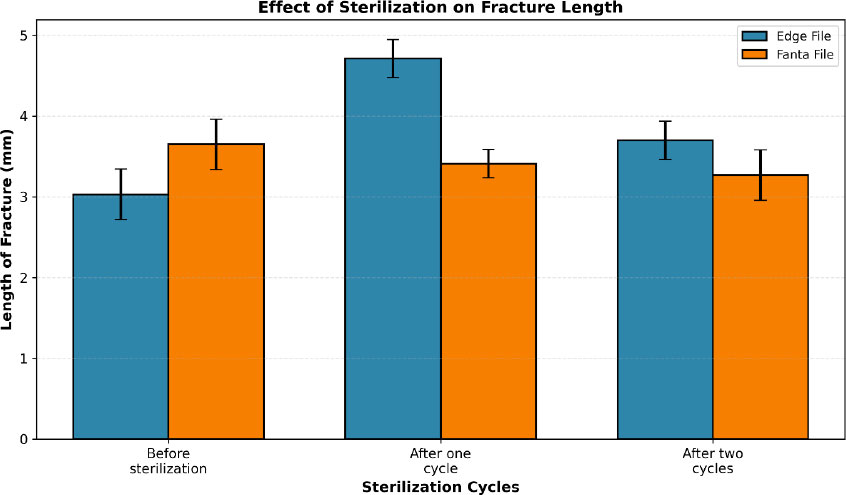
Comparative bar chart illustrating the effect of sterilization on the length of the fractured fragment for both file systems. Error bars represent 95% confidence intervals. No significant differences were observed between sterilization groups, suggesting fracture location remains consistent regardless of sterilization history.
3.5. Correlation Analysis
A weak negative correlation was found between the time to fracture and the length of the fractured fragment (r = -0.174, p = 0.112), as shown in the correlation matrix (Table 4 and Fig. 5). This suggests that there is no strong relationship between the length of a file and the length of the piece that breaks off.
| Parameter | Time to Fracture (TtF) | Number of Cycles to Failure (NCF) | Fracture Fragment Length |
|---|---|---|---|
| Time to Fracture (TtF) | 1.000 | 0.998*** (p < 0.001) |
-0.174 (p = 0.112) |
| Number of Cycles to Failure (NCF) | 0.998*** (p < 0.001) |
1.000 | -0.168 (p = 0.128) |
| Fracture Fragment Length | -0.174 (p = 0.112) |
-0.168 (p = 0.128) |
1.000 |
Note: Values represent Pearson correlation coefficients (r) with p-values in parentheses. *** indicates p < 0.001 (highly significant correlation). n = 84 total observations (6 groups × 14 files).
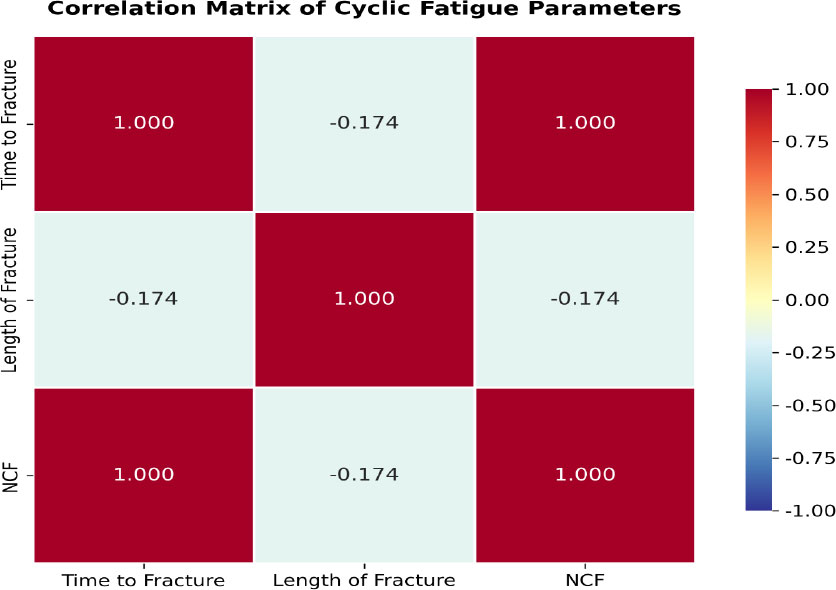
Heatmap of the correlation matrix for the measured cyclic fatigue parameters. Color intensity indicates correlation strength, with blue representing positive correlations and red representing negative correlations. The weak negative correlation (r = -0.174) between time to fracture and fracture length suggests these variables are largely independent.
3.6. SEM Fractography Findings
SEM Tests in all specimens exhibited the distinctive appearance of cyclic fatigue fracture upon examination of their fractured surfaces in SEM tests. More specifically, fractographic results indicated clear zones of crack initiation at the edges of the files with less tortuous and more mirror-like features. These turned into fatigue striations indicative of constructive, slow crack propagation inward. Structures at the centre displayed dimpled overload zones, indicative of catastrophic ductile failure Figure 6. Differences in the morphology of fractured files (sterilized–none) were noted, but these differences did not appear to indicate a fundamental difference in component fatigue failure, as fatigue resistance was reduced overall regardless of sterilization.
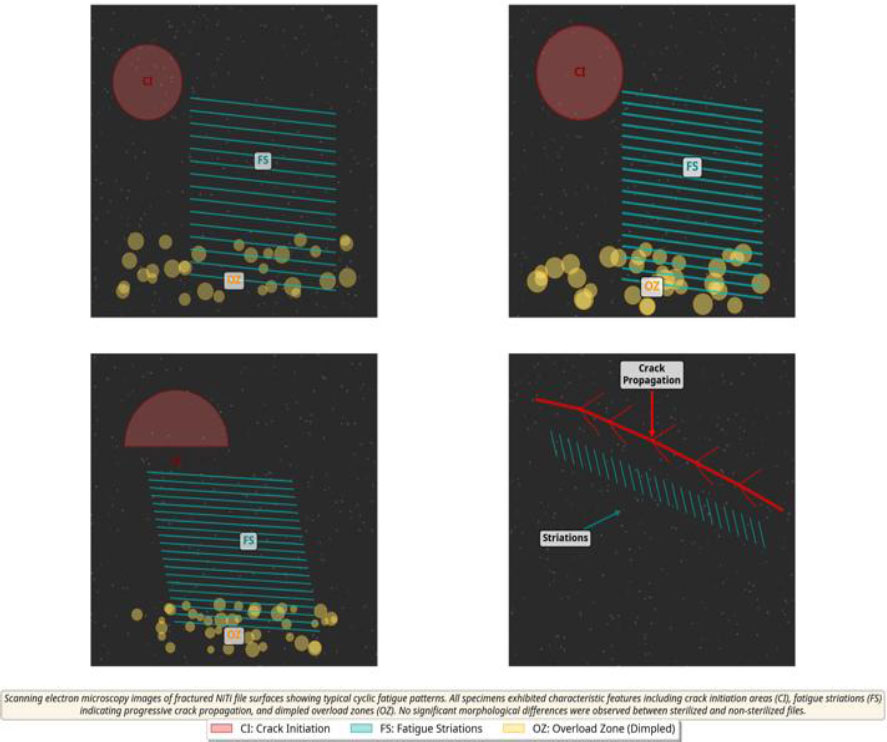
SEM Fractography of Cyclic Fatigue Fracture Surfaces. Representative scanning electron microscopy images showing typical cyclic fatigue fracture patterns. (A) EdgeFile X7 control (500×). (B) EdgeFile X7 after 2 sterilization cycles (500×). (C) Fanta File control (2000×). (D) High-magnification crack propagation detail (2000×). All specimens exhibited characteristic features including Crack Initiation areas (CI, red), fatigue striations (FS, teal), and dimpled overload zones (OZ, yellow). No morphological differences were observed between sterilized and non-sterilized groups. Scale bars represent relative magnification levels.
4. DISCUSSION
The present in vitro study confirms that autoclave sterilization significantly degrades the cyclic fatigue resistance of both EdgeFile X7 and Fanta File NiTi rotary instruments, leading to the rejection of the null hypothesis. This finding aligns with a substantial body of literature demonstrating the detrimental effects of autoclaving on the mechanical properties of NiTi alloys [18, 19]. The clinical implications of these findings are profound, particularly in the context of file reuse. While a single-use policy remains the gold standard for preventing both cross-contamination and fracture [9], the economic pressures of daily practice often make reuse a necessity. Our data suggest that even a single sterilization cycle significantly compromises the fatigue life of these instruments. For EdgeFile, the NCF dropped by 36.5% after just one cycle. This substantial decrease in durability must be factored into any clinical decision-making framework for file reuse. Based on our findings, we recommend that if these files are to be reused, it should be for a very limited number of cases, perhaps only one additional use, especially when negotiating canals with severe curvatures.
The most striking finding of this study is the significant interaction effect between file type and sterilization, indicating that the two systems responded differently to the autoclaving process. EdgeFile X7, which exhibited nearly double the initial fatigue resistance of Fanta File, suffered a much greater percentage reduction in its number of cycles to failure (38.6% vs. 19.5% for Fanta File after two cycles). This suggests that the proprietary FireWire™ heat treatment, while imparting superior initial durability, may render the alloy more susceptible to the microstructural changes induced by autoclaving compared to the AF-H Wire technology of the Fanta File. This differential response underscores that findings from one NiTi system cannot be extrapolated to another, a point reinforced by the conflicting results prevalent in the literature [20, 21]. The core of this degradation lies in the metallurgical response of the alloy to the high temperatures and pressures of the autoclave cycle. These conditions can induce microstructural alterations, such as the precipitation of brittle intermetallic phases (e.g., Ti2Ni, Ti4Ni3), which act as stress concentration points and facilitate crack initiation and propagation under cyclic loading [22, 23]. Recent studies, such as Karaś et al. (2025), have further corroborated that autoclave sterilization, especially after multiple cycles, increases surface roughness and causes microcracks in NiTi instruments, making them more prone to damage [24].
Our results contribute to a complex and often contradictory body of recent literature. Bardan et al. (2025), in a methodologically robust study using dynamic fatigue testing, found that autoclaving up to seven times did not affect the dynamic cyclic fatigue resistance of several modern NiTi systems. However, it did reduce torsional strength [13]. Conversely, Patel et al. (2025) reported an increase in cyclic fatigue resistance for other systems after autoclaving, postulating a beneficial shape-recovery or stress-relief effect [14]. This aligns with recent research by dos Reis et al. (2023), who found that replica-like instruments were reliable for up to two cases but showed significant SEM-visible distortions after the third use [19]. The discrepancy between our findings and those of Bardan et al. could be attributed to differences in the file systems tested (our study included EdgeFile and Fanta File, which were not in their analysis) and the testing methodology (static vs. dynamic fatigue testing). The static model used in our study, while standard, may represent a more aggressive test of pure cyclic fatigue by concentrating stress at a single point, potentially highlighting the effects of sterilization-induced micro-brittleness more readily than a dynamic test. This static method was deliberately preferred to dynamic testing, as it concentrates stress at a single, constant point of maximum curvature—allowing for reduced variability in the measurement and the assessment of pure cyclic fatigue resistance by highlighting effects from sterilization-induced micro-brittleness.
This study has several strengths, including a sample size determined by a priori power analysis, the use of a standardized artificial canal, and the inclusion of two contemporary, widely used file systems that have not been extensively compared in this context. Future research should aim to correlate mechanical testing with such metallurgical analyses to provide a more complete mechanistic understanding [25, 26].
In conclusion, this study provides clear evidence that even limited autoclave sterilization significantly reduces the cyclic fatigue resistance of EdgeFile X7 and Fanta File instruments. The magnitude of this reduction is system-dependent, with the initially more durable EdgeFile showing greater susceptibility to sterilization-induced degradation. These findings provide a crucial piece of evidence for clinicians, urging caution and suggesting a highly limited reuse protocol for these specific instruments to ensure patient safety and mitigate the risk of intraoperative instrument fracture during root canal therapy.
5. LIMITATIONS
The primary limitation of this method is the use of a static cyclic fatigue model at room temperature. Testing at body temperature (37°C) is critical, as the phase transformation behavior of many heat-treated NiTi alloys changes near this temperature, often leading to reduced fatigue resistance. Secondly, this investigation was limited to two sterilization cycles. Evaluating an extended series of cycles (e.g., 3, 5, 7) would offer a more complete picture of the degradation curve. Finally, our analysis did not include advanced metallurgical characterization such as Differential Scanning Calorimetry (DSC) or X-ray Diffraction (XRD), which could have provided direct evidence of the microstructural changes underlying the observed mechanical degradation. Future research should aim to correlate mechanical testing with such metallurgical analyses to provide a more complete mechanistic understanding.
CONCLUSION
Within the limitations of this in vitro study, it can be concluded that autoclave sterilization significantly reduces the cyclic fatigue resistance of both EdgeFile X7 and Fanta File NiTi rotary instruments. While EdgeFile demonstrated superior initial fatigue resistance (95.8% higher NCF than Fanta File), it was more negatively affected by repeated sterilization cycles, experiencing a 38.6% reduction in NCF after two cycles compared to 19.5% for Fanta File. The significant interaction effect between file type and sterilization (η2p = 0.42) confirms that the two systems respond differently to autoclaving. These findings underscore the importance of considering the effects of sterilization when making decisions about the reuse of heat-treated NiTi files in clinical practice, with recommendations for highly limited reuse protocols to ensure patient safety.
AUTHORS’ CONTRIBUTIONS
The authors confirm their contributions to the paper as follows: M.H.A.: Conceptualization, methodology, investigation, formal analysis, writing – original draft; S.A.K.: Data curation, statistical analysis, writing – review & editing; A.S.A.: Supervision, project administration, validation, writing – review & editing; S.M.I.: Supervision and critically revised the manuscript. All authors have read and approved the final manuscript.
ETHICS STATEMENT
This was an in vitro study and did not involve human or animal subjects. Therefore, no ethics committee approval was required.
AVAILABILITY OF DATA AND MATERIALS
The raw data supporting the conclusions of this article will be made available by the authors, without undue reservation.
FUNDING
This research did not receive any specific grant from funding agencies in the public, commercial, or not-for-profit sectors.
CONFLICT OF INTEREST
The authors declare that the research was conducted in the absence of any commercial or financial relationships that could be construed as a potential conflict of interest.
ACKNOWLEDGEMENTS
The authors would like to thank Al-Bayan University for providing the facilities and equipment to conduct this research. We also acknowledge the technical support provided by the laboratory staff.